A logo that looks sharp on one polo but shifts, puckers, or fades on the next is more than a decoration problem. It affects how customers see your team. That is the practical answer to why choose in house embroidery: when the people managing your order also control the stitching, they can protect the consistency, timing, and professional appearance your organization depends on.
For a medical office, restaurant, school, construction crew, or corporate team, uniforms are working assets. They need to hold up to daily use, match your brand standards, and arrive when new hires, seasonal staff, or an event schedule requires them. In-house embroidery gives your apparel provider more direct responsibility for each of those details.
Why Choose In House Embroidery for Better Control?
Embroidery has more moving parts than it may appear to. The garment fabric, logo size, thread colors, backing, placement, stitch density, and machine setup all influence the finished result. When decoration is handled in-house, the production team can see the actual garment and make informed decisions before a full order is completed.
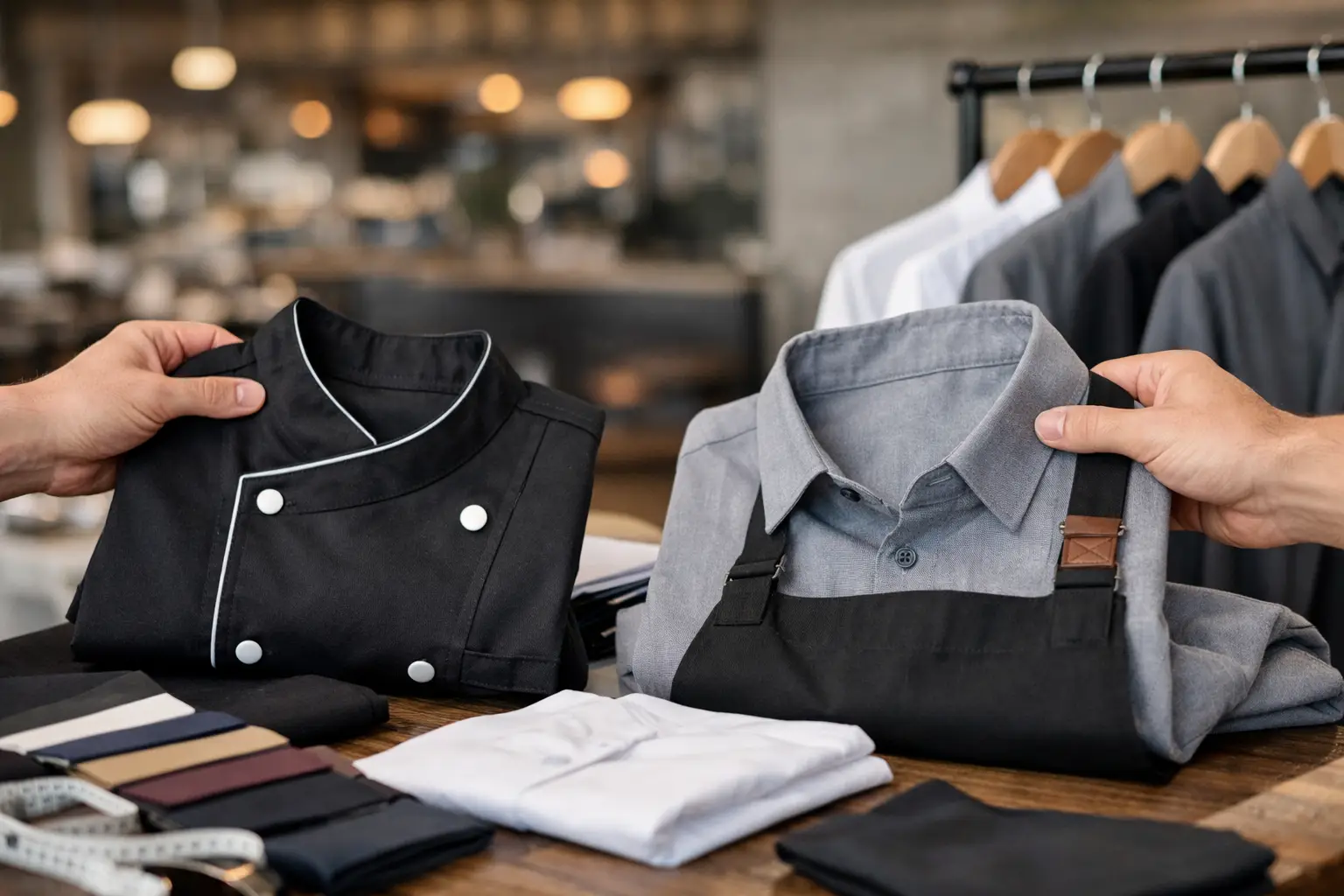
That matters when your logo is going onto very different pieces, such as lightweight performance polos, structured caps, fleece jackets, scrub tops, or heavy work shirts. A design that runs well on a cotton pique polo may need a different backing or adjustment on a thin moisture-wicking fabric. An experienced embroidery team can account for those differences rather than treating every garment as if it were the same.
Direct control also makes quality checks more meaningful. The team can inspect thread coverage, alignment, registration, and garment presentation during production. If something needs attention, the people who can evaluate it and correct it are close to the work itself. That reduces the risk of discovering a problem only after a shipment has traveled through several hands.
For organizations ordering uniforms on a recurring basis, consistency is especially valuable. Your staff should not receive one batch of embroidered shirts that looks noticeably different from the last. Maintaining digitized logo files, approved thread colors, placement specifications, and production notes helps keep your identity recognizable from order to order.
Faster Answers When Your Schedule Changes
Uniform programs rarely stay still. A practice hires new staff. A restaurant opens a patio for season. A school team reaches the playoffs. A municipal department needs additional garments before a public event. In those moments, the ability to speak with the team connected to production can save time and uncertainty.
In-house embroidery does not mean every rush request is automatically possible. Machine schedules, garment availability, logo complexity, and order volume still matter. A dependable provider will give you a realistic timeline instead of making a promise that creates problems later.
What it does mean is that questions can be answered with better information. Rather than waiting for updates between a sales office, a third-party decorator, and a shipping carrier, your provider can check the garment status and production schedule more directly. If there is a concern about a logo file, thread color, or placement, it can be addressed before it becomes a costly delay.
This is particularly helpful for Southwest Florida businesses that need flexibility through busy seasonal periods. Hospitality teams, event staff, healthcare offices, and service companies may add employees quickly. A local production partner with in-house capabilities can help plan replenishment orders around the reality of your staffing needs.
Your Brand Gets More Hands-On Attention
A uniform is often the first visual cue a customer notices. A clean embroidered logo can make a front-desk employee, technician, server, or sales representative look established and prepared. A poorly executed logo can have the opposite effect, even when the employee is doing excellent work.
In-house embroidery supports a more collaborative process from the beginning. Before production starts, the embroidery team can review whether your artwork will translate well into stitches. Fine lines, very small lettering, gradients, and tiny details may need to be simplified so the finished logo remains clear and readable.
That conversation is not a limitation. It is part of protecting your investment. A strong embroidery provider should explain what will work best on the garment you selected and recommend practical alternatives when necessary. For example, a detailed full-color logo might be ideal for a printed piece, while a simplified embroidered mark may look more polished on polos and outerwear.
The same attention applies to placement. Left-chest embroidery is a familiar choice for professional uniforms, but it is not the only option. Sleeve logos, cap fronts, jacket chests, names, monograms, and patches can all serve a purpose when they are planned around the garment and your team’s role. A knowledgeable local team can help you build a coordinated look without making every item feel identical.
In-House Does Not Mean One-Size-Fits-All
The best decoration method depends on the project. Embroidery is durable, dimensional, and well suited to polos, caps, dress shirts, outerwear, scrubs, and many workwear styles. It gives branded apparel a finished, professional appearance that works well for teams who regularly meet customers or represent an organization in the community.
However, embroidery is not always the best choice. Large, detailed graphics on T-shirts may be better suited to screen printing. Very lightweight fabrics may require special consideration. Some logos are too intricate to reproduce cleanly at a small embroidered size. A provider that offers multiple decoration methods can recommend the right approach instead of forcing every project into one process.
Large-volume jobs can also require careful planning. An in-house shop may have significant production capacity, but lead times should be discussed early for major events, multi-location rollouts, or seasonal uniform programs. The advantage is transparency: you can work with a team that understands the production schedule and can help organize your order around it.
What to Ask Before You Place a Uniform Order
Choosing a provider involves more than comparing a price per shirt. Ask who handles the embroidery, how your logo is prepared, and whether the team inspects decorated garments before delivery. You should also ask about approval procedures for new logos, turnaround expectations, reorder support, and the garment brands available for your type of work.
If your organization has multiple departments, consider how the uniform program will stay organized over time. You may need separate logos for divisions, employee names on selected garments, consistent colors across several apparel styles, or a simple way to reorder approved items. These details are easier to manage when your provider keeps clear records and understands the purpose behind each piece.
It is also wise to discuss the condition of any customer-supplied garments before they are decorated. Some items embroider well, while others may not be suitable because of fabric, construction, or previous wear. A straightforward conversation up front helps avoid avoidable surprises.
A Local Partner Makes the Process Easier
Working with a local company gives you a place to bring ideas, review garment options, and speak with people who understand the businesses and institutions in your community. Since 1986, United Uniforms / Sew Shore has served Southwest Florida organizations that need dependable uniforms, branded apparel, and decoration support without losing the personal attention that larger, distant vendors can struggle to provide.
For a new business, that may mean starting with a few polished polos and caps. For an established organization, it may mean building a repeatable program for hundreds of employees across departments. Either way, in-house embroidery creates a closer connection between your goals, the garments selected, and the finished product your team wears.
The next time you order uniforms, bring more than a logo. Bring the job each garment needs to do, the people who will wear it, and the schedule you are working against. That gives your embroidery partner the information needed to create apparel that represents your organization well from the first shift onward.