A uniform order can look simple until it has to work across a busy shift, a humid afternoon, multiple body types, and a growing team. This custom uniform buying guide is built for the people responsible for getting it right: office managers, practice administrators, restaurant owners, school leaders, coaches, and local business operators who need their teams to look professional without creating an ordering headache.
The best uniform program is not necessarily the least expensive shirt or the most elaborate logo treatment. It is the combination of appropriate garments, dependable decoration, consistent sizing, and a plan for reorders. When those pieces are decided before production begins, your team receives apparel that supports the work they do and represents your organization well.
Start With the Job, Not the Garment
Before choosing colors or embroidery locations, consider where and how the uniform will be worn. A front-desk team has different needs than a landscaping crew, a medical practice, or a restaurant kitchen. The job determines the level of comfort, durability, visibility, and care required.
For Southwest Florida organizations, heat and humidity should be part of the decision from the beginning. Lightweight performance polos may make sense for outside sales teams, hospitality staff, and field crews, while cotton-rich work shirts can be a better match for roles that need a more traditional appearance. Medical teams may prioritize scrub fabrics with stretch and easy-care performance. Schools and sports programs may need garments that stand up to frequent washing and active use.
Ask employees what makes their current uniform difficult to wear. Common issues include fabric that feels too heavy, shirts that shrink, limited size availability, and logos that are uncomfortable or poorly positioned. That feedback is useful. A uniform employees will actually wear correctly is more valuable than one that looks good only on a sample table.
Build a Uniform System, Not a One-Time Order
A polished appearance comes from consistency, but consistency does not mean every employee needs the exact same garment. A uniform system can include several approved options that share the same logo, color palette, and standard of decoration.
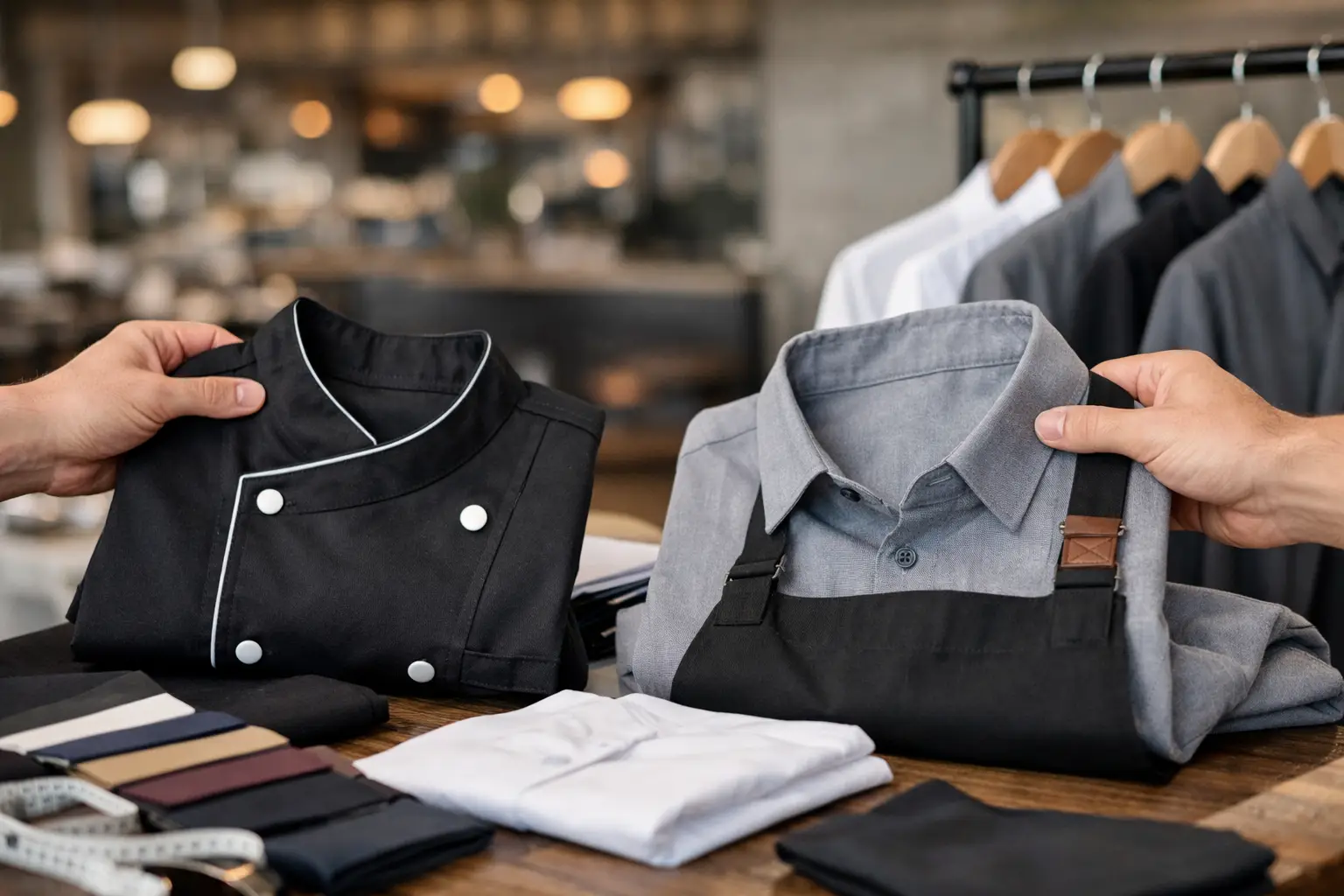
For example, a restaurant may use embroidered button-downs for management, polos for hosts, chef coats for kitchen leadership, and aprons for service staff. A healthcare office might combine branded scrubs, warm-up jackets, and administrative polos. The garments differ, but the presentation remains cohesive.
This approach also makes seasonal changes easier. A long-sleeve layer, quarter-zip, or lightweight jacket can be added for cooler indoor spaces or early-morning work without changing your team’s visual identity. Establish the approved garments up front, then employees and managers know what to reorder as staffing changes.
Decide What Must Stay Consistent
Choose a few elements that should not vary between garments: your approved logo file, thread or ink colors, logo placement, and the general tone of the apparel. A navy polo and a navy jacket do not have to be identical, but they should clearly belong to the same organization.
If name personalization is needed, set a standard for it as well. Decide whether names appear on the opposite chest, above a pocket, or on a sleeve, and whether job titles are included. Small choices like these prevent a uniform program from becoming uneven over time.
Choose Fabric for Real Working Conditions
Fabric affects comfort, appearance, cost, and the life of the garment. There is no single best choice, because the right option depends on the role and the care routine your team can realistically follow.
Cotton offers a familiar feel and can be a strong choice for casual staff apparel, school spirit wear, and some workwear. It may shrink or hold moisture more than synthetic options, so garment construction and laundering instructions matter. Polyester and performance blends are popular for active, outdoor, and hospitality roles because they are lightweight, colorfast, and often better at managing moisture. Blends can provide a balance of softness, durability, and easier care.
For workwear, look beyond fabric content. Reinforced seams, stain resistance, snag resistance, and appropriate garment weight can make a meaningful difference in how the uniform performs. For scrubs, stretch, pocket layout, and movement through a full shift may be more important than a garment’s initial price.
Request samples or have key decision-makers try on comparable styles when possible. A garment that looks right in a catalog can feel very different after several hours of wear.
Get Sizing Right Before Production
Sizing is one of the most common sources of frustration in custom uniform orders. Brand sizing varies, and a medium in one style may fit more like a large or small in another. Do not rely only on what employees usually wear in retail clothing.
Use size charts, fitting samples, or a sizing event for larger teams. Give employees a clear deadline to confirm their size, especially when personalized garments cannot be returned or exchanged. It is also smart to account for inclusive size ranges at the product-selection stage rather than treating extended sizes as an afterthought.
When ordering for a new team or a fast-growing department, consider adding a small number of blank garments in frequently needed sizes. This can help cover immediate staffing needs while a personalized reorder is produced. The right reserve inventory depends on your turnover rate, budget, and how essential uniform compliance is to the role.
Select the Right Decoration Method
Your logo, garment fabric, order quantity, and intended use all influence whether embroidery, screen printing, patches, or another method is the best fit. The goal is not to choose the most decorative option. It is to choose a method that looks sharp and holds up under normal wear.
Embroidery creates a professional, dimensional finish and is a natural choice for polos, woven shirts, outerwear, hats, scrubs, and corporate apparel. It is especially well suited to smaller chest logos and name personalization. Fine details and very small lettering may need adjustment so the stitched design remains readable.
Screen printing works well for larger artwork, bold graphics, team shirts, event apparel, and higher-quantity orders. It can be an efficient option when the same design is being applied to many garments. The fabric matters here too. A print that works beautifully on cotton may need a different ink approach for performance polyester.
Patches can add a durable, structured look to uniforms, jackets, hats, and public-safety or service apparel. They are often a practical solution when a logo includes fine detail or when a specific uniform tradition calls for a patch. A qualified decoration partner can help determine whether the artwork needs cleanup, color matching, or a simplified version for the selected application.
Plan Your Logo and Placement Carefully
A logo should be readable from a reasonable distance and sized appropriately for the garment. Bigger is not always better. An oversized left-chest logo can pull on a lightweight polo, while a detailed logo reduced too far may lose its legibility.
Provide the best version of your artwork available, preferably a clean vector file when one exists. If your organization has brand standards, share approved colors and any rules about logo use. This helps maintain consistency across shirts, hats, bags, promotional products, and future orders.
Think about the employee’s role when selecting placement. Left chest is a dependable choice for most business uniforms. Sleeve decoration can work well for a secondary logo, department identifier, or sponsor recognition. Back prints offer visibility for field teams, events, and service businesses, but they may not be appropriate for every customer-facing setting.
Look Beyond the Per-Piece Price
A lower-priced garment can cost more over time if it fades quickly, loses its shape, or needs replacing after a short period. Likewise, an extremely premium option may not be necessary for a role with high turnover or demanding physical work. The right budget is tied to expected wear, replacement frequency, and the impression the role needs to make.
When comparing quotes, make sure you understand what is included: garment cost, decoration locations, setup or digitizing requirements, name personalization, and any special handling. Compare like for like. A quote for a basic cotton tee with one-color printing is not directly comparable to a moisture-wicking polo with embroidered logos and individual names.
It is also wise to consider the cost of inconsistency. Ordering from several sources may seem convenient, but mismatched colors, logo sizes, and garment quality can weaken a team’s appearance. A single, organized program makes it easier to maintain standards as your organization grows.
Set Up Reorders Before You Need Them
The first order is only the beginning. New hires arrive, employees need replacements, promotions create new title requirements, and seasonal uniforms change. A reorder plan prevents last-minute decisions that lead to mismatched apparel.
Keep a record of approved styles, colors, decoration locations, and logo versions. Note which garments were successful and which generated complaints. If a particular polo ran small or a fabric did not perform well in the field, make that part of the next-order decision.
At Sew Shore, local organizations can work with an experienced team that understands both the retail side of uniforms and the production details behind decorated apparel. That combination is valuable when you need help coordinating garments, embroidery, screen printing, patches, and branded items under one consistent program.
Questions to Ask Before Approving Your Order
Before giving final approval, confirm the artwork proof, spelling of names and titles, garment colors, sizes, decoration placement, and expected production timeline. Ask what happens if an item becomes unavailable and whether there is an approved substitute that will maintain your program’s look.
For larger orders, ask for a production sample or clear proof when the project includes new artwork, multiple locations, or complex personalization. It takes less time to review a proof carefully than to correct a completed order.
A well-planned uniform does more than put a logo on a shirt. It helps employees feel prepared, helps customers recognize who they can trust, and gives your organization a professional presence at every shift, event, and first impression.